Ctrl/

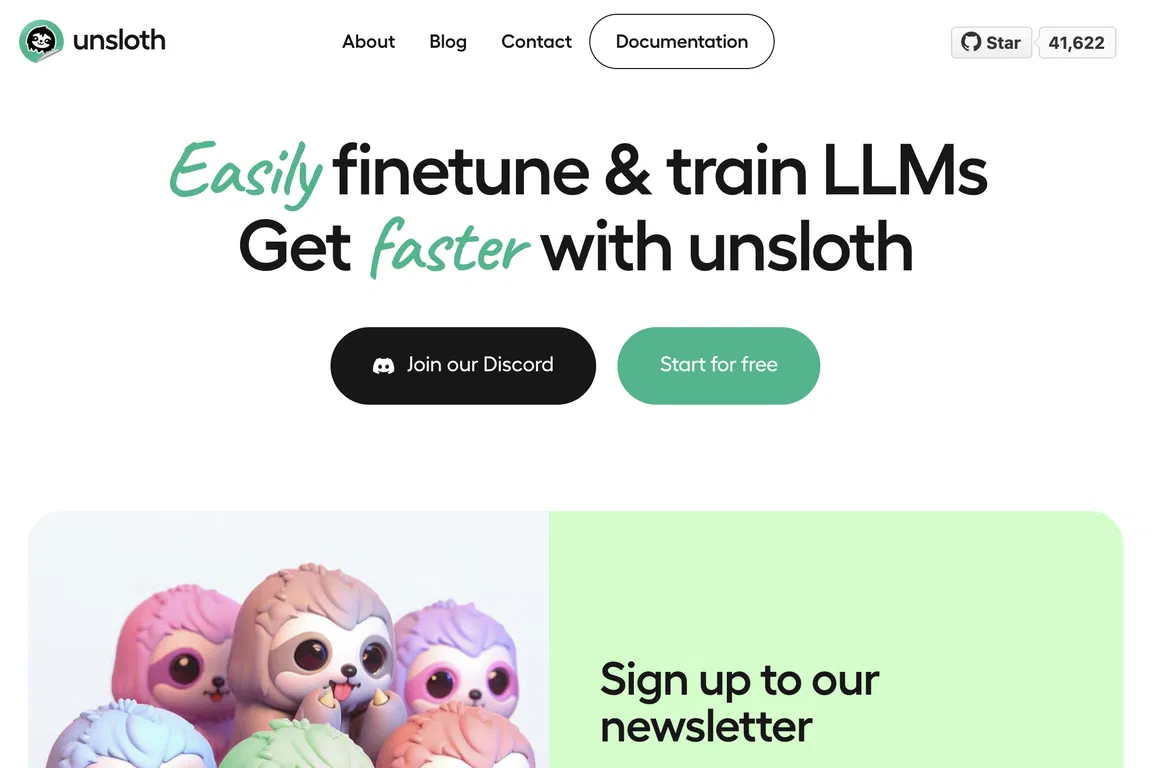
Unsloth is an open-source, user-friendly tool tailored for fine-tuning and reinforcement learning across various language learning models (LLMs) such as Llama 4, DeepSeek-R1, Qwen3, Gemma 3, and Mistral.
It simplifies the process of training and fine-tuning LLMs, significantly reducing the time involved. With Unsloth, users can manually perform complex mathematical calculations and create custom GPU kernels, resulting in a faster training process without requiring hardware changes.
The Unsloth system is compatible with a range of GPUs, including NVIDIA GPUs from Tesla T4 to H100, and it can also be used with AMD and Intel GPUs.
This compatibility allows for broad adaptation and extensive use. Users can access free fine-tuning using a single NVIDIA GPU on popular platforms like Google Colab or Kaggle Notebooks.
Additionally, a free standard version of Unsloth is available, along with Pro and Enterprise versions that offer faster training, reduced VRAM usage, and other enhancements.
Unsloth's goal is to simplify AI training, enabling users to run LLMs and training more efficiently and quickly to address rising hardware costs and performance limitations.
They are also focused on accelerating inference speed. Unsloth is used by major organizations like Microsoft, Nvidia, Facebook, and NASA, among others.
Train Models
Large Language Models
LLM (Large Language Support) Integrated to Convert Lyrics to Descriptive Prompts for Images and Videos and Export to Plugins.
LLM
Local Stable Diffusion (NVIDIA / CUDA, also CPU), Video Generations via Online Providers
User-friendly design
Open-source platform
Compatible with various LLMs
Primarily for language learning models
Involves manual math derivation
May need GPU proficiency
Released 1 year ago
Free + from $14.99
Released 2 years ago
Free + from free tier available
Released 5 months ago
Free + from $25/month

Released 6 years ago
Free
Released 3 years ago
From $49/month
Released 1 year ago
Contact for pricing
Released 3 years ago
Free + from free tier available
Released 2 years ago
Free + from free tier available
Released 4 years ago
From $500/month
Released 3 years ago
Free + from $12/month