


Description
Feedly for Threat Intelligence is an AI-driven tool designed to track emerging cyber threats in real time. At its heart, the platform uses an AI engine to aggregate, evaluate, and prioritize threat intelligence from a wide array of sources.
It allows users to monitor key vulnerabilities and zero-day exploits, investigate the activities of specific threat actors and malware, understand the threat landscape for particular industries, and track specialized cybersecurity topics. Feedly AI processes millions of articles, reports, and social media posts daily, automatically tagging key threat intelligence elements such as threat actors, critical vulnerabilities, indicators of compromise, industries, companies, ATT&CK techniques, and vendors, among others.
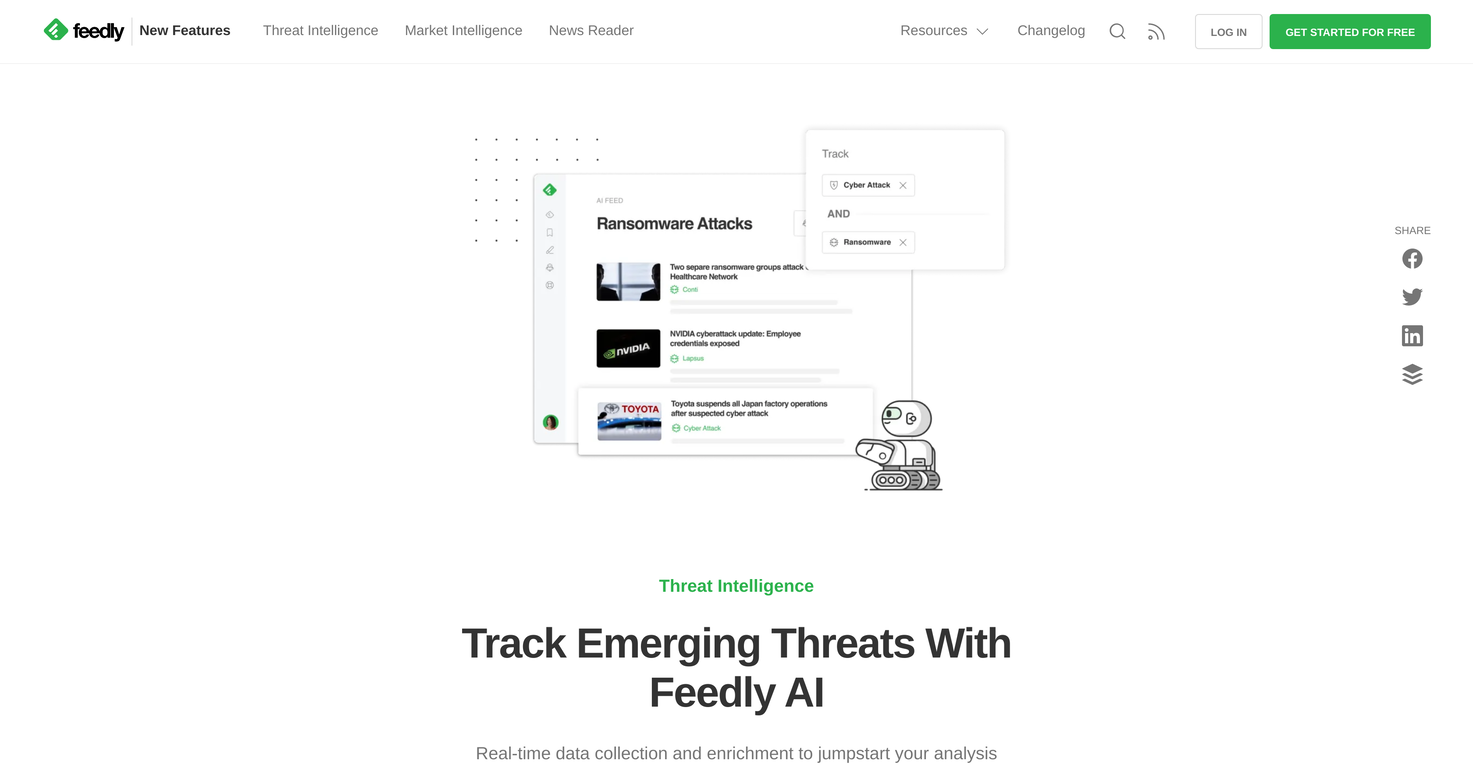
The AI Feeds feature provides an interactive interface for tracking and searching, allowing near real-time access to this intelligence. Creating an AI Feed involves a three-step process: first, AI models are applied to define the intelligence to be gathered.
Next, symbolic logic operators (AND, OR, NOT) are used to combine multiple AI models and narrow the search focus. Finally, if needed, the sources are refined by adding user-specified trusted sources.
AI Feeds allows adding content to personal or team folders. Articles, reports, or social media posts that match the defined AI models will appear in the AI Feeds.
The tool includes several pre-trained AI models, simplifying the process of converting intelligence requirements into AI Feeds.
Pricing Plans
Releases
Reviews
Pros & Cons
Pros
Filters information rapidly
Prioritizes relevant content
Allows user-defined topic prioritization
Cons
Limited compatibility across platforms
Requires an internet connection
Requires initial training by the user